
From Brief to Finished Product: How We Manage a Custom Factice Bottle Project
A custom factice bottle is more than an enlarged copy of a perfume or cosmetic package.
For fragrance, beauty, and cosmetics brands, a successful display bottle must reproduce the key visual characteristics of the original product while also meeting practical requirements for structure, stability, surface finish, transport, and retail installation.
Proportion, bottle shape, cap construction, transparency, color, logo placement, surface quality, and packaging can all influence the final result.
If these details are only discussed after production begins, the project may face unnecessary revisions, delays, and additional cost.
At Caamatech, we therefore place strong emphasis on early communication, technical documentation, approval checkpoints, project management, and quality control.
From the first inquiry to production drawings, fabrication, final inspection, packing, and shipment, each stage has a clear purpose.
Here is how a typical custom factice bottle project moves from initial concept to finished product.
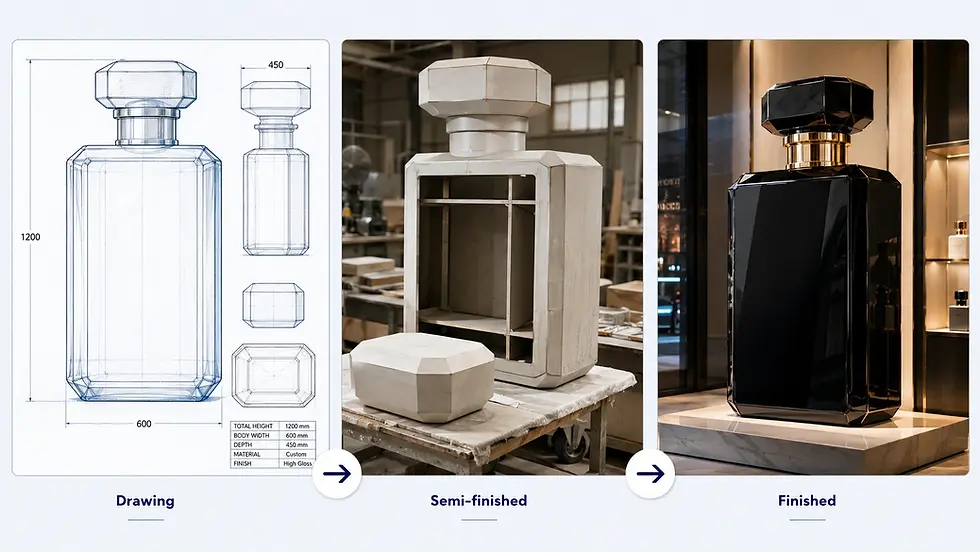
1. Initial Communication: Understanding the Project
Many projects begin with only a real product, a photograph, or a general display concept.
The first step is to understand what the client wants to achieve and help them understand what production methods and finishes are available.
Depending on the project, we may provide references for:
Previous factice bottle projects
Material options
Surface finishes
Transparent and translucent effects
Metallic and mirror finishes
Logo and label applications
Different bottle structures
This helps the client establish a clearer visual direction before detailed engineering begins.
For clients producing a factice bottle for the first time, this stage can be particularly useful.
A request such as “premium,” “close to the real bottle,” or “suitable for a luxury window display” still needs to be translated into actual materials, finishes, and production methods.
Our project team helps turn a creative idea into information that can be quoted and manufactured.
2. Collecting the Basic Information
Before preparing an accurate quotation, we normally confirm several key project details.
Product Dimensions
We need to understand:
Overall factice bottle height
Bottle body dimensions
Cap dimensions
Required scaling ratio
Whether the model should follow the original product proportion
Dimensions affect not only appearance but also internal structure, stability, packing volume, and transportation.
Quantity
A single prototype, several event props, and a multi-store rollout may require different production approaches.
Quantity is therefore an important part of quotation and production planning.
Product References
Clients can provide:
Product photographs
Official product images
Videos
Technical drawings
3D files
Physical samples
The more complete the reference information, the more accurately the project can be evaluated.
Application
We also need to know where the bottle will be used, such as:
Shopping mall displays
Store windows
Beauty counters
Fragrance launches
Pop-up stores
Trade shows
Photo shoots
Brand events
Long-term retail installations
Different environments require different levels of stability, durability, weight control, and finish quality.
Collecting this information early is an important part of our project management process.
The clearer the project information is at the beginning, the lower the risk of revisions later.
3. After Quotation: Technical Information and Finish Confirmation
Once the preliminary quotation is accepted, the project moves into more detailed technical communication.
We normally focus on three main categories of information.
A. Physical Product Sample
If the client can provide an original product sample, it becomes an important reference for production.
A physical sample allows us to evaluate:
Overall proportions
Bottle curves
Cap structure
Product color
Transparency
Surface gloss
Logo position
Label size
Relationships between different components
This is especially useful for irregular bottles, transparent fragrance bottles, and products with complex caps.
If a physical sample is not available, high-quality images, videos, and accurate dimensions may be used instead.
However, for projects requiring high dimensional and visual accuracy, more complete references generally lead to more reliable results.
B. Drawings and 3D Files
If the client already has a 3D model or complete technical drawings, these can be supplied for project evaluation and production preparation.
For simple geometric bottles, accurate dimensions and clear photographs may be enough to develop production drawings.
For complex bottles with curved surfaces, irregular geometry, sculptural details, or unusual profiles, additional work may be required, such as:
3D modeling
Physical scanning
Detailed digital reconstruction
Structural redrawing
Additional modeling or scanning costs may apply in these cases.
Whenever possible, we discuss these requirements before production begins.
Identifying technical complexity early helps control both budget and lead time.
C. Logo and Label Files
Brand details have a major impact on whether the finished factice bottle looks authentic.
We normally request:
Logos
Labels
Product text
Graphic artwork
Brand colors
Printing files
Vector files are preferred, including formats such as:
AI
EPS
Vector PDF
CDR
High-quality vector artwork helps maintain sharp edges and accurate details when the graphics are enlarged.
Low-resolution images may become blurred when scaled up and may require artwork reconstruction before production.
4. Production Drawing Approval
Production drawing approval is one of the most important stages of the entire project.
Renderings, photographs, and chat messages are useful for understanding the concept, but production requires a clear technical reference.
The level of documentation can vary depending on the project.
Type A: Brand Projects and High-Accuracy Projects
For brand clients, major campaigns, multi-store projects, or bottles requiring higher accuracy, we may prepare more detailed information such as:
3D views
Overall dimensions
Front views
Side views
Proportional relationships
Bottle and cap structure
Logo position
Label position
Color and finish descriptions
This gives the brand, design team, and factory a common reference.
For larger projects, these documents also become an important project-management tool.
Type B: Simpler Projects
For bottles with relatively simple structures, a simplified dimension drawing may be sufficient.
It can show:
Height
Width
Depth
Diameter
Main structure
Finish requirements
Logo position
Regardless of the drawing format, one principle remains important:
Production drawings should receive written client approval before manufacturing begins.
This creates a clear reference for both production and final quality inspection.

5. Manufacturing the Factice Bottle
Once drawings and finishes are approved, the project can move into production.
Depending on the bottle structure, manufacturing may involve:
CNC machining
Mold making
Acrylic fabrication
Resin or fiberglass molding
Metal fabrication
Sanding
Painting
Polishing
Transparent-effect finishing
Metallic-effect finishing
Logo production
Label application
Final assembly
A large factice bottle may look simple from the outside, but its internal structure often requires additional engineering.
For example, a cap that works perfectly on a small perfume bottle may become too heavy when enlarged directly. Transparent sections may also need different material thicknesses to maintain a clean appearance.
We therefore consider more than visual similarity.
The production team also evaluates:
Structural stability
Large-scale proportion
Deformation risk
Transportation
On-site handling
Close-range surface quality
6. Project Management During Production
For custom projects, product quality and project management are closely connected.
Clients need to know not only whether something can be manufactured, but also:
Whether production follows the approved information
Which stage the project has reached
Whether the schedule remains under control
Whether any process has changed
Whether the final product matches expectations
Whether inspection has been completed
A typical project moves through clear checkpoints:
Requirement Confirmation → Quotation → Technical Information → Finish Approval → Production Drawing Approval → Manufacturing → Final Inspection → Client Approval → Packing → Shipment
This checkpoint-based process helps keep the client, project team, and production team aligned.
It becomes particularly valuable for multi-product projects, retail rollouts, and major brand campaigns.
7. Final Quality Inspection
After production is complete, the bottle is not immediately packed for shipment.
A final inspection is carried out first.
Appearance
We check:
Overall shape
Surface smoothness
Visible scratches
Color consistency
Surface contamination
Paint quality
Cleanliness of transparent components
Proportion
We review:
Bottle proportion
Cap proportion
Logo scale
Label position
Relationships between major components
Finish
Depending on the project, inspection may include:
Mirror finish
Metallic finish
Painted surface
Acrylic edges
Joints
Logos
Printed graphics
Transparency
Stability
For oversized models, we also check:
Base stability
Tipping risk
Connection strength
Ease of reassembly after transportation
8. Photo and Video Approval Before Shipment
For international projects, clients may not be able to inspect the product at the factory personally.
We therefore use detailed photographs and videos to show the finished condition before shipment.
These may include:
Front views
Side views
Rear views
Multi-angle high-resolution images
Logo details
Cap details
Surface-finish close-ups
Full-product videos
Detail videos
The client can compare the finished product with the previously approved information and review the:
appearance, finish, proportion, and branding details.
Only after this stage is completed does the project move into packing and shipment.
This makes the production process more visible and reduces communication gaps in international projects.
9. Packing Is Part of Product Quality
A factice bottle may leave the production floor in perfect condition, but poor packing can still result in scratches, breakage, or deformation during transportation.
For this reason, packing is considered part of the quality process.
Depending on the size, weight, finish, and shipping method, protection may include:
Surface protection film
EPE foam
EVA protection
Protective foam
Corner protection
Separately packed components
Reinforced cartons
Plywood crates
Internal fixing structures
Mirror, transparent, high-gloss, and special painted surfaces require additional scratch protection.
When appropriate, large bottles can also be designed in modular sections so that caps, bodies, or decorative parts can be packed separately and assembled on site.
10. Shipment and Final Project Delivery
After packing is completed, the project moves into shipment.
For projects containing several bottle styles, multiple cartons, or deliveries for different stores, clear packaging identification is important.
Boxes can be organized using:
Product numbers
Style numbers
Store numbers
Project numbers
This helps clients identify components quickly when goods arrive and reduces confusion during installation or distribution.
For us, delivery is not simply the moment the product leaves the factory.
A successful project should arrive in a condition that allows the client to identify, handle, and use the finished product efficiently.
Why Project Management Matters in Custom Factice Bottle Production
A factice bottle project connects several different stages:
Brand Concept → Product Information → Engineering → Materials & Finishes → Manufacturing → Quality Inspection → Packing → Logistics
A misunderstanding at any stage can affect the final product.
For this reason, a capable custom display manufacturer needs more than fabrication skills. It also needs a structured project-management process.
At Caamatech, we focus on several key principles:
Confirm Important Information Early
Dimensions, quantity, physical samples, drawings, logo files, and application requirements should be clarified as early as possible.
Use Physical Samples and Drawings as Key References
Complex three-dimensional products are difficult to reproduce accurately from web images alone.
Discuss Technical Costs Before Production
If 3D modeling, scanning, or special production processes are required, they should be identified before manufacturing begins.
Approve Production Drawings Before Manufacturing
We avoid relying only on verbal descriptions for critical dimensions and structure.
Complete Inspection Before Shipment
Products are inspected in the factory, reviewed through photos and videos when required, and only then packed for shipment.
These checkpoints help reduce project risk and improve consistency.
Quality Is Built Into the Process
Quality control is sometimes understood as a final inspection performed after production.
For custom factice bottles, quality begins much earlier.
If the dimensions are wrong at the start, final inspection cannot correct the proportions.
If the logo artwork is too low in resolution, careful manufacturing cannot create a sharp enlarged graphic.
If a complex bottle is modeled incorrectly, even an excellent paint finish cannot reproduce the original shape accurately.
This is why we focus on:
building quality into the project from the first communication, rather than searching for problems after production is complete.
Through requirement confirmation, technical evaluation, drawing approval, finish confirmation, production management, and pre-shipment inspection, the entire project becomes more transparent, controlled, and efficient.
Build Your Custom Factice Bottle With Caamatech
Caamatech provides custom factice bottle manufacturing and retail display production for fragrance brands, cosmetics brands, visual merchandising agencies, retail design companies, event companies, and commercial display contractors.
We can support projects including:
Perfume factice bottles
Cosmetic display bottles
Oversized factice bottles
Giant perfume bottles
Window display bottles
Mall display props
Product-launch props
Branded event display bottles
Send us your product photographs, dimensions, quantity, physical sample, 3D files, or brand artwork.
Our team can support the project from initial communication through technical evaluation, quotation, production drawings, manufacturing, quality inspection, packing, and final delivery.
For a custom project, our goal is not simply to deliver a model bottle.
It is to deliver a well-managed project with a clear path from concept to finished product.


Comments